
Oregon City Resident Lookup Record Paths
A useful Oregon City search distinguishes roles. A parcel record identifies property context, not every occupant. A recorded instrument shows a dated party interest, not a present address. A court file places a named party in a case, while a vital index supplies a life-event clue. The strongest result keeps the source, date, and role beside the name. Start with the source that fits the fact already known, then add a second, different anchor before treating two records as the same person.
| Record | What It Confirms | Where | Access |
|---|---|---|---|
| CMap and Assessment & Taxation | Physical parcel and jurisdiction context; an owner-information route | Clackamas County CMap and Assessment & Taxation | CMap omits owner names; ask the custodian about owner information |
| Recorded instruments | Dated party interest and legal description | Clackamas County Clerk Recording Division | Public research, copy, or focused-request path |
| Court docket | Named party in a defined case and procedural history | OJCIN Online or the Circuit Court clerk | Subscription online; terminal, counter, and copy routes vary |
| Vital index | Life-event or relationship lead | Oregon Archives, OHA, OHRI, and library microfilm | Index differs from a certified record and has time limits |
| Voter channel | A voter’s own registration status or an authorized list process | Oregon My Vote, SOS, and Clackamas County Elections | Personal service or controlled request, with exemptions |
| Probate or estate file | Estate number and relevant representative trail | Circuit Court or historical OHRI route | Use the case number; protected material remains restricted |
Property, court, vital, voter, and probate records are not interchangeable. In Oregon City, a mailing address may be a dated contact clue, and an owner may not live on the parcel. The official custodian, rather than a copied listing, is the place to ask about a record’s scope or a correction.
Verify Oregon City Resident Records
Use a two-anchor check for a name. Preserve every original spelling, including initials and middle names, because the Oregon Historical Records Index mirrors original documents and a variation can be the clue that separates two people. For Oregon City research, write down the source date, the record role, and the place shown. A same surname by itself is weak. A dated legal description plus a permit date, an index event plus a dated obituary, or a court case number plus independently known business or mailing detail gives a more defensible match.
- Write the full name as it appears in the first reliable item, including initials, middle name, and alternate spellings.
- Choose one dated anchor, such as a parcel context, a life-event index entry, a court case number, or a local newspaper reference.
- Search a second official system that answers a different question, then compare date, place, and role instead of surnames alone.
- Record the case number, document title, index entry, or exact citation before requesting a copy from its custodian.
- Stop where a record is sealed, confidential, or restricted, and use the custodian’s stated process rather than trying to infer withheld details.
- Docket
- The court’s dated list of actions and filings in one case. It is not a finding that every listed person has a current connection to Oregon City.
- Index and image
- An index points to a record. An image is a view of the underlying document, which may be unavailable, redacted, or subject to a separate access rule.
- Certified copy
- A copy authenticated by the custodian for the purpose stated on the request. It is different from an index hit or an ordinary page copy.
Oregon City OJCIN Party Paths
OJCIN Online, the Oregon Judicial Case Information Network, is the statewide court access product for registered subscribers. The search context matters. Choose Party for civil, family, probate, and Tax Court matters. Choose Defendant for criminal, traffic, and parking matters. A blank or incorrect context can hide a useful result. A nonmatch still does not prove that a person has no court record, because case type, access limits, date range, spelling, and sealing affect what can be seen.
| Search By | Choose Party for civil, family, probate, and Tax Court, or Defendant for criminal, traffic, and parking. |
|---|---|
| Party Information | Name, Business, or State Identification Number mode. |
| Name fields | Last and first name are required in Name mode; middle name and date of birth are optional refiners. |
| SID fields | SID and State are required in SID mode; the guide permits omission of dashes. |
| Case filter | All, Open, or Closed status, with optional filed-on or filed-before dates. |
| Wildcard and sort | The OJD guide supports wildcards for surname research and shows Filed Date sorting. |
Search a full name with one independent anchor, narrow by status or filing date when available, and write down the case number. For an Oregon City case, a Case No. link can open available documents where the system provides access. The actual file, an old stored item, or a certified copy can require the clerk route.
Note: A case number identifies one court file more reliably than a name alone when requesting clerk assistance.
Oregon City Resident Lookup Result Fields
An accessible OJCIN result path can show the party or defendant identity as entered, a case number, case and court context, status or date filters, and the Register of Actions. For an Oregon City search, the Register is the procedural-event list for the case. Linked documents appear only when the Case No. path makes them available. Do not assume every result includes an address, date of birth, charge detail, disposition, or document image. Those fields vary by case type and access level.
- Identity anchor: the name entered, or a business or SID choice when that mode was used.
- Case anchor: case number and court context, needed for a focused copy request.
- Timing anchor: filed date and docket events that place the case in time.
- Status filter: all, open, or closed when that filter was applied.
- Register of Actions: the sequence of procedural events, not a general person profile.
Juvenile, adoption, many protected family matters, sealed or expunged cases, and confidential information are not general public name-search material. Court access should answer a narrow documented question, such as locating a known estate file or checking the docket for an identified case number.
Oregon City Circuit Court Channels
Clackamas County Circuit Court is the state trial-court route for civil, criminal, family, probate, and related files. It is not the County Clerk Recording Division. For records help, the court lists its counter at 1000 Courthouse Road in Oregon City, phone 503-655-8447 option 7. Counter hours are weekdays from 9 a.m. to 4 p.m.; phones are answered from 8 a.m. to 4 p.m. Public viewing stations in Public Service Center Room 1060 cover documents filed from December 4, 2015 onward. Ask first whether a particular case is available for public inspection.
The Clackamas court records page is the source for the counter, terminal, copy, and storage guidance.
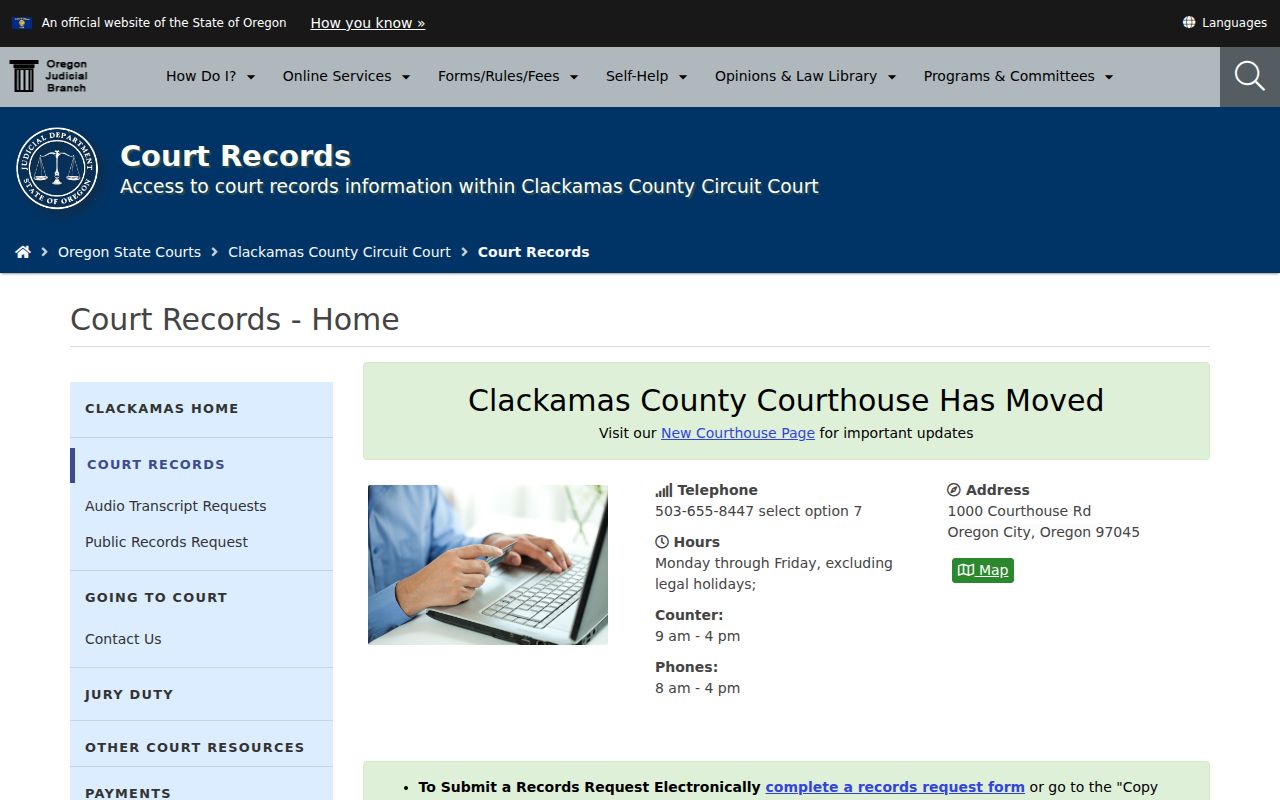
Files created before December 2015 are off-site and require three days’ notice. Ordinary copies cost $0.25 per page, certification adds $5, and exemplification adds $10, with actual search, compilation, sorting, review, redaction, copying, mailing, or supervision costs where applicable. An Oregon City request should state the case name, case number, requested documents, and whether certification or exemplification is needed.
Oregon City Municipal Court Boundaries
Oregon City Municipal Court is separate from Circuit Court. It handles most city and state traffic offenses within city limits and most misdemeanors. It is a limited-jurisdiction court and generally not a court of record, except as its local rules specify. It does not handle DUII, civil, or small-claims matters. Its office is in the Robert Libke Safety Building at 1234 Linn Avenue, Oregon City, open Monday through Friday from 8 a.m. to 5 p.m., with phone 503-905-3675 and email ocmuni@orcity.org.
The Oregon City Municipal Court page identifies its scope and contact route.
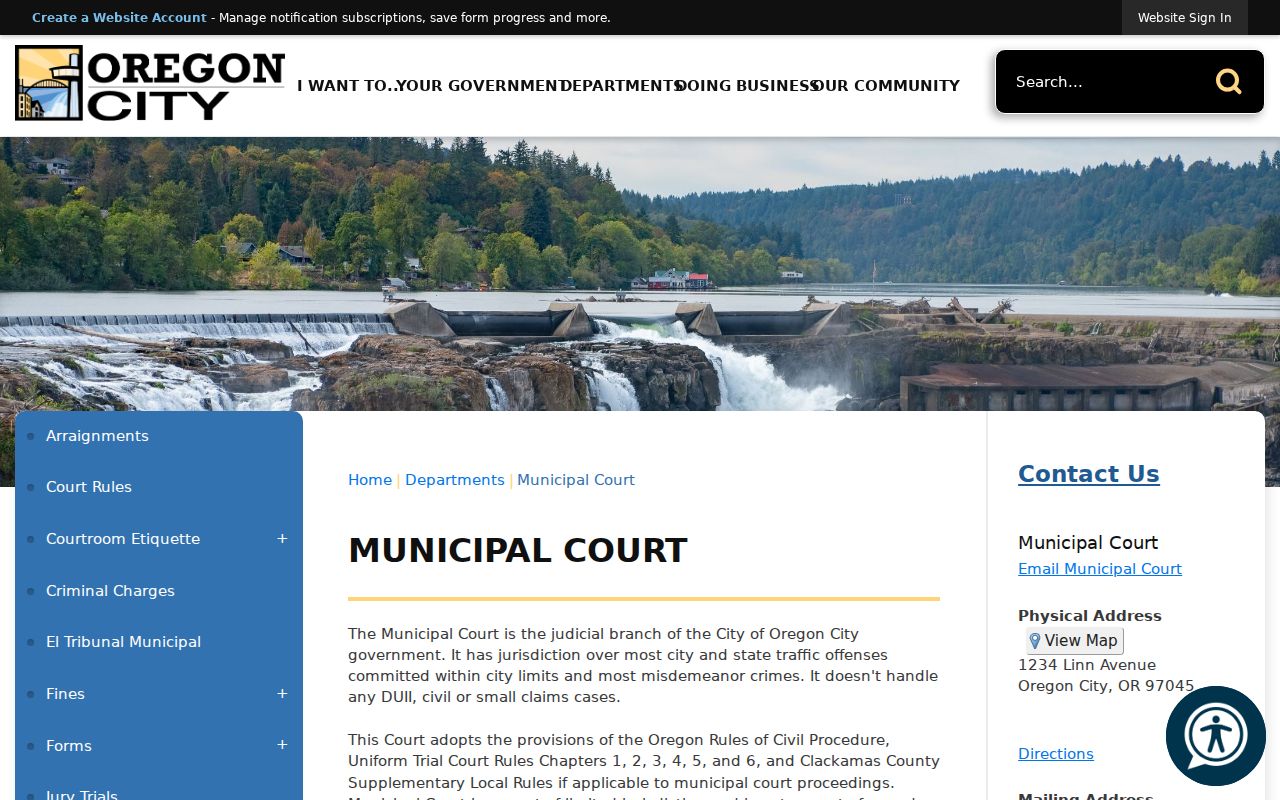
The court’s non-government records-request form sets a $15 fee before processing. It asks for the request date, requester contact information, defendant name and date of birth, case number, and a description of the request. A case number is best, but enough defendant and date detail can help the court locate the file. Confidentiality and sealing rules can still limit access.
Note: Municipal Court jurisdiction is limited, so a city citation request cannot replace a Circuit Court records inquiry.
Oregon City Vital Index and Certificates
Oregon Archives vital-record guidance separates historical index research from current certified records. Birth records are restricted for 100 years after the birth, while death, marriage, and divorce records are restricted for 50 years. The Oregon Health Authority Center for Health Statistics issues certified Oregon birth, death, marriage, domestic-partnership, divorce, and dissolution records. An index hit is not a certificate and does not bypass current eligibility rules.
Oregon Archives is the source for the historical vital-record opening windows and research routes.
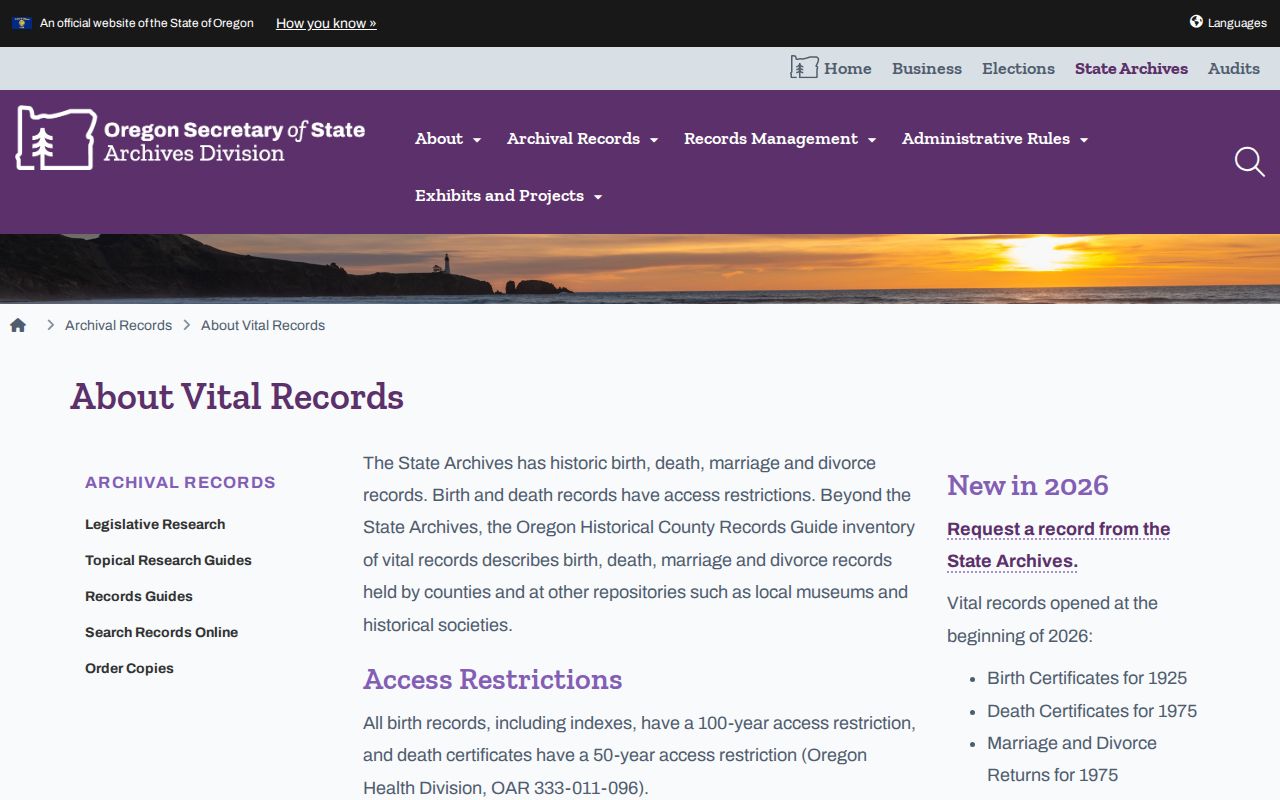
For restricted records, the OHA process requires an eligible relationship or legal purpose and identification under OAR 333-011-0096. Oregon City requesters can use authorized online or phone service, mail, Portland drop box, and scheduled in-person appointment. The State Archives and Oregon Historical Records Index are the historical route; the library’s marriage and divorce indexes are local leads. Use the record-specific live order instructions for current fee and timing information.
Oregon City Voter Status Routes
Oregon My Vote is an individual’s authenticated way to check or update their own registration and election information. It takes a name and date of birth in its personal flow. It is not a public browser for finding people by street, checking a whole block, or treating a nonmatch as proof about another person. Clackamas County Elections is the local office for defined election questions, while the Secretary of State manages the statewide electronic voter-list request process.
The Oregon Secretary of State voter-list request procedure is the source for the controlled statewide request path.
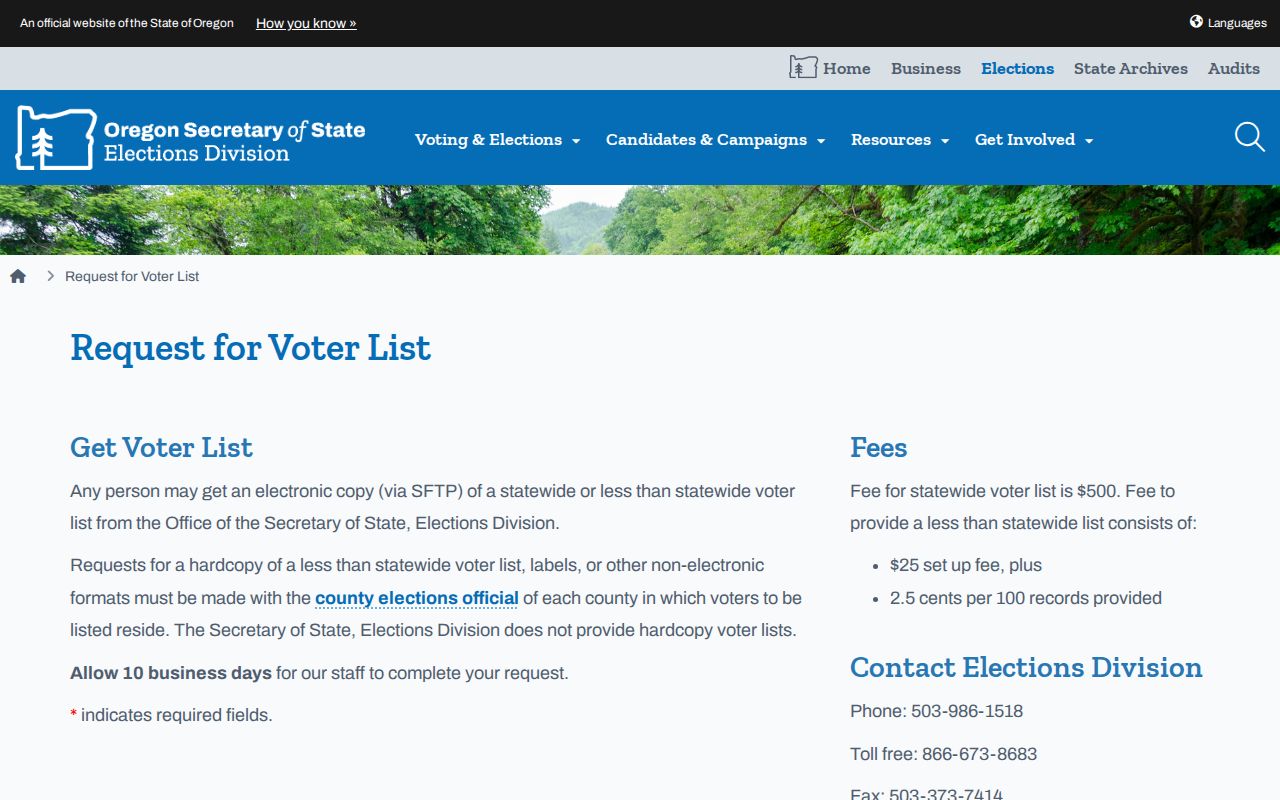
An Oregon City voter-list request has statewide or smaller-jurisdiction options, a fee schedule, electronic delivery context, and use restrictions. The requester identifies the desired jurisdiction, format, and use under the live state process. Allow up to 10 business days as the state page states. Ballot choices are secret, and protected voters or Address Confidentiality Program participants may have information withheld.
Note: My Vote remains personal even when a state voter-list request is available through a separate official process.
Oregon City Yearbook Leads
For documented former-classmate or family-history research, Oregon City High School yearbooks in the library’s Oregon Collection date from 1910. A yearbook can establish a spelling, school connection, and time marker. It cannot establish a present residence. The Wilmer Gardner Research Library at the Museum of the Oregon Territory adds books, maps, microfilm, obituaries, biographical material, unindexed vital and burial material, and a research-request route for a more grounded historical trail.
Follow a dated yearbook or newspaper lead through the historical collection rather than using it as a current-person claim. The Oregon City Directory Book details the library shelf, newspaper runs, and limits of the verified directory evidence.
Oregon City Resident Lookup Limits
Oregon’s Address Confidentiality Program can provide a substitute mailing address and related assistance to qualifying survivors. It does not erase every underlying record or permit anyone to work around an exemption. Election address exemptions use a separate county-clerk and Secretary of State process. CMap deliberately omits owner names online, My Vote is personal, vital records have time and eligibility limits, and some court material is confidential or sealed. A withheld result is a limit to respect, not a gap to fill with inference.
Lawful use. Use Oregon City records for a lawful personal, family-history, estate, civic, or safety question. Do not use a partial record hit to stalk, harass, threaten, or target anyone.
For a wrong government record, contact the office that created it and follow its correction process. Do not reproduce sensitive identifiers from a recorded image. DMV data is not an address-verification fallback, and protected voter, court, and vital information remains protected even when another dated record is accessible.
Note: A record’s date and custodian are as important as the name, especially when multiple people share a surname.